

Executive Summary
Johnson Matthey encountered challenges synchronizing supplier master data between Coupa and SAP MDG due to differing data models and inconsistent key mappings. Alluvion implemented a scalable integration using SAP’s Data Replication Framework and standard APIs, supported by custom mapping and validation logic. The solution accurately translated Coupa’s multi‑entity supplier structure into SAP’s Business Partner model while preventing duplicate records. Automated workflows enabled early data enrichment, auditable approvals, and consistent governance. As a result, Johnson Matthey improved data quality, reduced supplier onboarding time, and established a future‑ready foundation for global expansion.
Introduction
Johnson Matthey, a global chemicals and sustainable technologies company, encountered challenges when synchronizing supplier master data between Coupa and their SAP Master Data Governance (MDG) system.
To address these challenges, Alluvion supported Johnson Matthey in integrating Coupa via the Data Replication Framework. The solution leveraged standard APIs, custom enhancements, and optimized workflow configurations to ensure seamless and reliable data synchronization across platforms.
Business Challenges
Data Model
Coupa and SAP MDG structure supplier data differently. For Johnson Matthey, client-specific logic was needed to translate between both modeling approaches and maintain accurate supplier relationships in both systems.
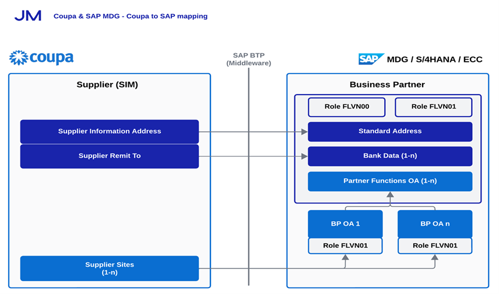
As part of Coupa's Supplier Information Management (SIM) module, a supplier is represented through a Supplier Info record holding the main supplier details, separate Remit-To details used during the remittance process, and one or more Supplier Sites for additional addresses.
This structure does not map directly onto SAP, where the supplier is modeled as a single Business Partner (BP) record representing the legal entity. This main BP carries the complete dataset for the supplier: the standard address, bank details, company code data, and purchasing organization data.
The Coupa Supplier Info address is mapped to the standard address of the main BP entity. The Remit-To details are mapped to the bank data of the main BP entity and the Supplier Sites from Coupa are represented in SAP as ordering addresses. Every site is created as its own Business Partner carrying the different address and is linked back to the main BP entity through partner functions.
The main BP therefore holds the full supplier data, while its partner functions point to the sub-entities that represent the different ordering addresses. For Johnson Matthey, this pattern ensures that the richer Coupa model is consistently translated into one main supplier in SAP with its ordering addresses attached as linked partner BPs.
System Integration
Missing key mappings between both systems led to misclassifications, where supplier updates were sometimes treated as new record creations. The system had to accurately distinguish between new supplier creation requests and updates to existing records to prevent the creation of duplicates. Additionally, incomplete or invalid source data required enrichment to meet SAP MDG's data validation standards.
Workflow and Scalability
Johnson Matthey needed auditable workflows with a dynamic approval routing for special supplier categories. With global operations and expansion plans, the system had to handle high data volumes without performance issues while ensuring zero business disruption.
Implementation Details
Inbound Integration
Standard SAP webservices were configured to enable automatic Change Request creation in MDG when suppliers are created or modified in Coupa.
The solution automatically determines whether to create new supplier records or update existing ones. The enhanced key mapping validation logic was used to ensure proper linkage between the Coupa and MDG records and prevent any duplicate supplier creations.
For the more complex branch supplier scenarios, the system extracts the ordering address information upon creation of the Change Request and presents it as structured notes. This enables business users to efficiently create and link branch suppliers to their main vendor records in SAP MDG.

Process Governance Enhancements
A strategic "Global Requestor" enrichment step was introduced at the beginning of the approval workflow, allowing a comprehensive data validation and enrichment before routing to the appropriate MDG approvers. This ensures incomplete data can be enhanced with the required supplier information such as company code details, tax information, and payment terms.
Outbound Integration Configuration
Once the MDG Change Request is completed, the outbound integration sends the approved and activated supplier data back to Coupa utilizing the Data Replication Framework. Selective replication filters were configured to ensure only relevant suppliers are sent out.
Multiple trigger points for replication can be used:
- Automatic upon change request activation
- Manual replication
- A custom mass replication tool which was used during the initial data migration from MDG to Coupa.
Results & Benefits
The SAP MDG-Coupa integration delivered substantial improvements across Johnson Matthey's supplier management processes:
Operational Excellence
Automated workflows reduce supplier onboarding time while intelligent validation eliminated duplicate supplier records and decreased manual data entry errors.
Enhanced Governance
The solution establishes complete audit trails for all supplier creations and changes with full traceability, while automated compliance checks reduce review time. The dynamic workflow assignments provide clear ownership and accountability throughout the approval process.
Data Quality Improvements
The integration creates a single source of truth for supplier master data with real-time synchronization preventing data discrepancies. Consistent validation rules ensure data integrity and reliability.
Scalability and Flexibility
The implementation builds a robust foundation for a future global rollout beyond the initial UK operations, with configurable business rules allowing adaptation to local requirements without requiring code changes.
Key Takeaways
This Coupa integration demonstrates the potential of SAP Master Data Governance integrated with external procurement platforms. By addressing synchronization challenges, a solution has been delivered that drives business value.
Key lessons include the importance of custom enhancements and developments for things like handling branch suppliers, custom key mapping logic, custom migration tools, and most importantly, comprehensive testing.
The project's success was a result of our deep understanding of both SAP MDG's technical capabilities and the unique requirements of global procurement processes. This expertise enabled us to deliver a solution that addresses current needs while providing flexibility to evolve with future requirements.
Organizations facing similar challenges with master data silos or procurement system integrations can benefit from our proven methodology and focus on SAP MDG implementations. Our consultative approach ensures expert guidance from initial assessment through go-live and beyond, transforming complex data governance challenges into opportunities for sustainable competitive advantage.
Let's Make Your Story Next!
Your own success story awaits. Click below to begin your personalized experience.
Let's embark on this journey together!
Connect Now for Your Success Story